
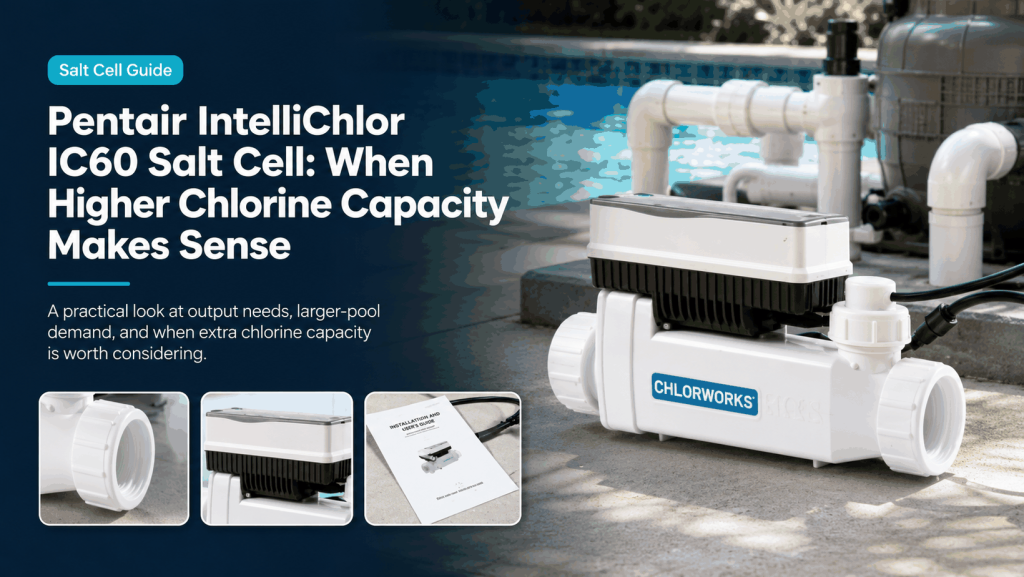
The Pentair IntelliChlor IC60 Salt Cell is the high-capacity option in the IC20/IC40/IC60 family. It is relevant not only to pools near 60,000 gallons, but also to compatible installations where an owner wants more production headroom for long swim seasons, intense sun, heavy bather load, or water features. Oversizing should still be deliberate. A larger […]
Tag Archives: Salt Cell Care
Salt Cell Replacement
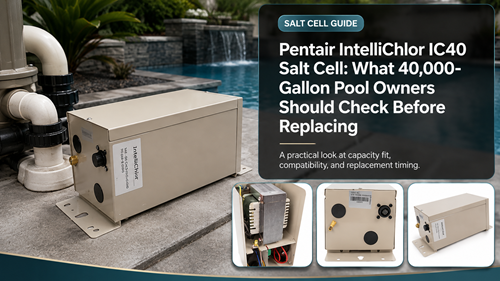
Pentair IntelliChlor IC40 Salt Cell: What 40,000-Gallon Pool Owners Should Check Before Replacing
26
Aug
Aug
The Pentair IntelliChlor IC40 Salt Cell is a common choice for medium-to-large inground pools because it offers substantially more output than the IC20 while fitting the same IntelliChlor family. Pentair identifies the IC40 as the up-to-40,000-gallon model, with actual daily production determined by runtime and output setting. A 40,000-gallon owner should avoid treating the cell […]
24
Aug
Aug
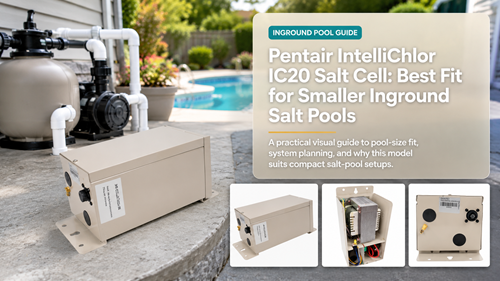
The Pentair IntelliChlor IC20 Salt Cell is designed for smaller inground salt pools that do not need the output capacity of the IC40 or IC60. Pentair identifies the IC20 as the up-to-20,000-gallon model, but owners should treat that number as a maximum capacity reference, not a promise that every 20,000-gallon pool will operate comfortably at […]
Salt Cell Replacement
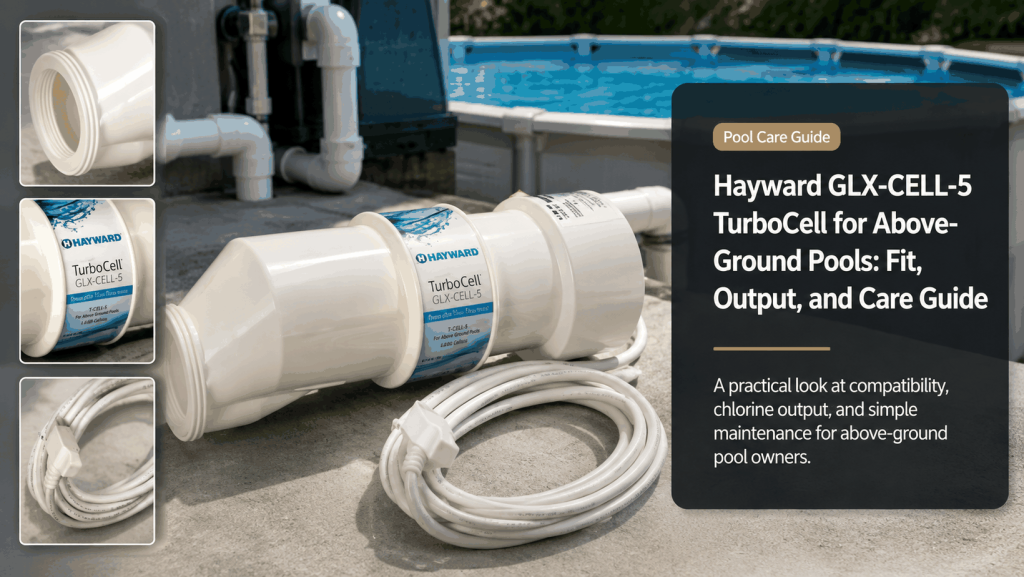
Hayward GLX-CELL-5 TurboCell for Above-Ground Pools: Fit, Output, and Care Guide
07
Aug
Aug
The Hayward GLX-CELL-5 TurboCell sits in a different buying context from the larger inground AquaRite cells: above-ground pools often use shorter seasonal run periods, hose or return-jet plumbing, and compact control systems. That makes physical fit and system family just as important as gallon rating. Before replacing the cell, confirm whether low chlorine is caused […]
Salt Cell Replacement
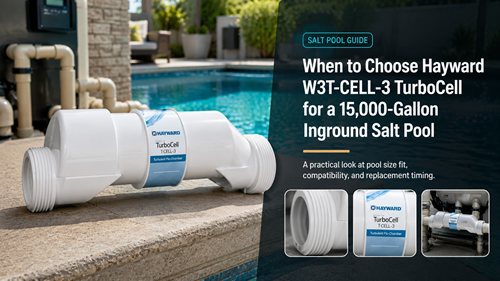
When to Choose Hayward W3T-CELL-3 TurboCell for a 15,000-Gallon Inground Salt Pool
05
Aug
Aug
The Hayward W3T-CELL-3 TurboCell is a compact AquaRite cell option for smaller inground salt pools, but the 15,000-gallon rating should be treated as a sizing ceiling rather than the only buying criterion. Sun, heat, swimmer load, pump runtime, stabilizer, and water balance all influence how hard the cell must work. For replacement owners, the simplest […]
Salt Cell Replacement
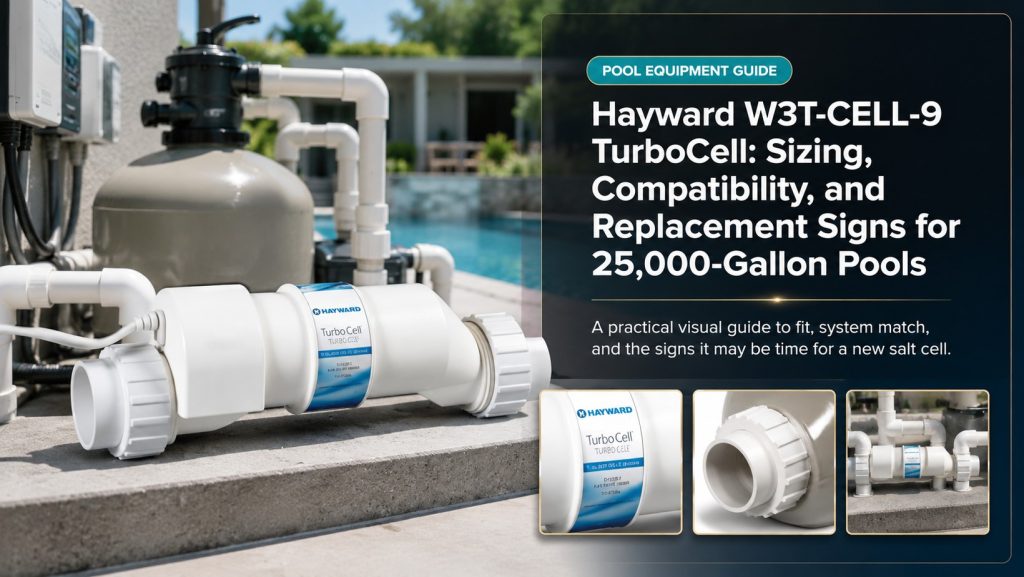
Hayward W3T-CELL-9 TurboCell: Sizing, Compatibility, and Replacement Signs for 25,000-Gallon Pools
03
Aug
Aug
The Hayward W3T-CELL-9 TurboCell is easiest to buy correctly when you treat capacity, controller compatibility, and cell condition as three separate checks. A pool that is close to the 25,000-gallon rating can be a reasonable match, but actual chlorine demand changes with sun exposure, swimmer load, water temperature, circulation time, stabilizer level, and seasonal conditions. […]
21
Jul
Jul
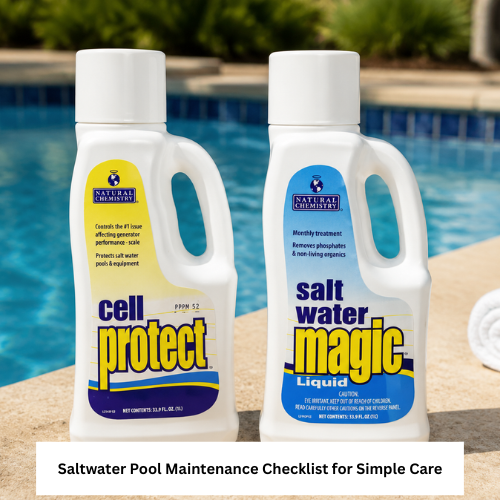
A practical saltwater pool maintenance routine combines water testing, circulation checks, cell inspection, surface cleaning, and seasonal planning. A salt system makes chlorine from dissolved salt, but it does not remove the need to monitor water balance, filters, equipment, and sanitizer output. Record readings instead of relying only on the generator display. Follow the pool […]
20
Jul
Jul
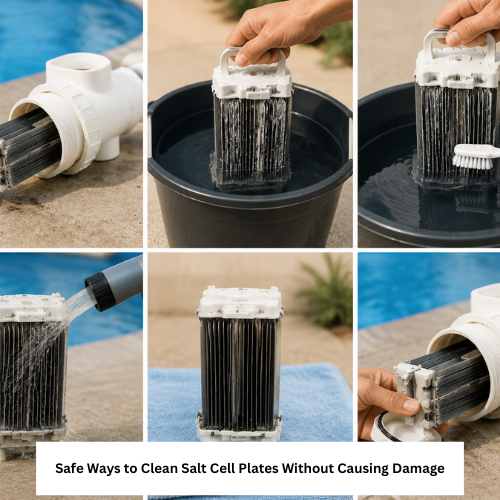
Before you clean salt cell plates, shut down the circulation system, disconnect power as instructed, and confirm the cell model and cleaning procedure in the manufacturer manual. Cleaning too often or using the wrong tool can shorten cell life, damage coatings, or create a chemical safety risk. Salt cell cleaning should begin with inspection rather […]