
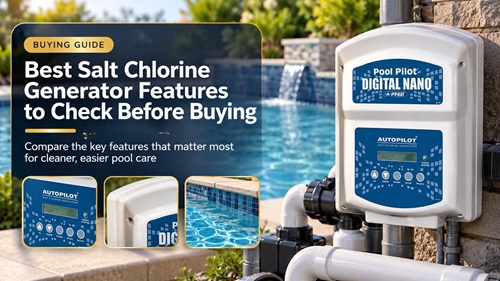

The best salt chlorine generator is not simply the model with the largest advertised pool capacity. Good buying decisions come from matching chlorine output, cell size, pump runtime, plumbing, electrical requirements, flow protection, diagnostics, automation compatibility, warranty terms, and replacement-cell cost to the pool you actually operate.
A system that is comfortably sized for normal and peak demand can run at a lower percentage than an undersized cell that is pushed near maximum output all season. Before comparing price, verify pool volume and equipment-pad constraints so feature comparisons are based on compatible products.
Best Salt Chlorine Generator Features Start with Correct Sizing
Manufacturers commonly advertise a maximum pool volume, but two pools of the same size can have very different chlorine demand. Hot sunny weather, long swim days, warm water, debris, stabilizer level, and pump runtime all affect how much chlorine must be produced. Capacity headroom is valuable because it gives the owner room to increase production without operating at 100 percent continuously.
Use the actual pool volume and expected operating conditions when reviewing pool equipment features. If the system cannot produce enough chlorine during peak demand, a long feature list will not solve the sizing problem.
Also verify that the replacement cell and controller are intended to work together. A physically similar cell is not automatically electronically compatible.
Features Worth Paying Attention to Before You Buy
Cell Design and Serviceability
Modern chlorine cell technology can include salt-status indicators, cell-life information, polarity cycling, low-temperature protection, and diagnostic feedback. Compare what the controller actually reports and how the cell is inspected or replaced.
Automation Integration
If the pool already has pool automation, confirm whether the generator can communicate with that control platform or whether it will operate only as a stand-alone device. Integration can simplify output changes but should never replace water testing.
Installation Requirements
Review salt system installation details before ordering: straight-pipe length, cell orientation, flow-switch placement, bonding, electrical supply, controller mounting clearance, and local code requirements can affect the total project cost.
Upgrade Path and Replacement Parts
Good pool upgrade solutions have parts that can be serviced independently. Compare replacement-cell availability, sensors, boards, unions, and whether the controller can support a larger compatible cell later.
Accessories and Consumables
When shopping swimming pool accessories, look beyond the initial bundle. Unions, flow switches, cleaning stands, power centers, and replacement cells can affect installation convenience and future ownership cost.
Feature Comparison Checklist
| Feature | Why It Matters | Buying Question |
|---|---|---|
| Rated pool volume | Sets the basic sizing class | Is there enough headroom for peak demand? |
| Chlorine output | Shows production capability better than volume alone | How much chlorine can the cell produce per day? |
| Flow protection | Prevents generation without circulation | Is a flow switch or pump-status integration included? |
| Salt diagnostics | Helps detect operating-range problems | Does it show an estimated salt level or only warning lights? |
| Automation support | Simplifies centralized control | Is it compatible with the automation already installed? |
| Replacement-cell cost | Major long-term ownership expense | Is the correct genuine or approved cell readily available? |
| Warranty and support | Matters if the controller or cell fails early | Are DIY installation rules or registration requirements involved? |
Verify the Equipment Pad Before Ordering
Pre-Purchase Measurements and Checks
- Calculate pool volume
- Photograph existing plumbing and controller labels
- Measure available straight pipe and wall space
- Confirm pump voltage and electrical service with a qualified professional
- Identify current automation system
- Check the manufacturer salt range
- Price the correct replacement cell
- Read the current installation manual and warranty
Compatibility mistakes are expensive because a cell may fit the pipe while still being wrong for the controller or power center. Use a salt chlorinator compatibility guide to verify model families and electrical requirements before relying on a marketplace description.
Features That Should Not Distract from the Basics
Wi-Fi, apps, touchscreens, and detailed dashboards can improve convenience, but they do not compensate for incorrect sizing, poor flow, or unbalanced water. Similarly, a long warranty is only useful when the owner understands its installation, registration, water-chemistry, and service conditions.
A practical buying hierarchy is capacity first, compatibility second, safety and diagnostics third, serviceability fourth, then convenience. That order helps separate meaningful features from marketing extras.
Choose for the Whole Ownership Cycle
The best salt chlorine generator for a specific pool is the one that can meet chlorine demand without being overstressed, fits the existing equipment pad, provides understandable diagnostics, and has replacement parts you can realistically source. Evaluate the controller and cell as a long-term system rather than a one-time purchase.
Once installed, continue routine chlorine and pH testing and adjust output based on results. Good features make operation clearer; they do not remove the need for water-care decisions.
Frequently Asked Questions
Should I buy a salt generator rated exactly for my pool size?
Usually it is better to have reasonable capacity headroom, especially in hot climates or heavily used pools, while still following manufacturer sizing guidance.
Is chlorine output more useful than the gallon rating?
Both matter. Output gives a more direct view of production capability, while gallon rating provides the manufacturer sizing context.
Do I need a flow switch?
The system must have a reliable way to prevent chlorine generation without adequate water flow. The exact method depends on the product design.
Is app control necessary?
No. It can be convenient, but correct sizing, diagnostics, water testing and serviceability are more important.
What long-term cost should I compare before buying?
Replacement-cell cost, expected cell life, sensors or control parts, and any required professional service should be included with the initial purchase price.
