
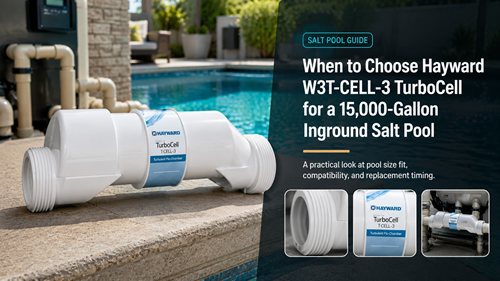
The Hayward W3T-CELL-3 TurboCell is a compact AquaRite cell option for smaller inground salt pools, but the 15,000-gallon rating should be treated as a sizing ceiling rather than the only buying criterion. Sun, heat, swimmer load, pump runtime, stabilizer, and water balance all influence how hard the cell must work.
For replacement owners, the simplest path is to match the existing cell model, confirm the controller’s supported cell types, and verify that low output is really a cell problem. A correctly sized new cell cannot compensate for poor flow, incorrect salt, or a controller set to the wrong TurboCell type.
Where The Hayward W3T-CELL-3 TurboCell Fits Best
Start with a reliable pool-volume calculation using measured length, width, average depth, and shape. A 15,000-gallon label is most useful when the pool’s actual volume is known; a guessed number can put the cell at its upper limit without the owner realizing it.
The model-specific listing provides a useful T-Cell-3 sizing guide for matching the cell to a smaller inground pool.
Size For Peak Conditions, Not An Easy Week
A cell that is adequate during spring can feel undersized during the hottest part of summer. If the pool often needs long pump cycles and high output percentage just to maintain the target free chlorine, compare the long-term operating plan before replacing like-for-like.
A separate 15,000 gallon chlorination cell listing is useful for comparing model naming and ensuring the planned replacement is actually the T-3 class.
Controller And Plumbing Compatibility
Compatibility is more than fitting between two unions. The controller must recognize the installed cell type, the cable and connector must be correct, and the cell should be installed in the orientation required by the system documentation. Do not alter electrical connections to force a fit.
For a new or substantially changed small inground salt pool setup, compare the complete chlorination system rather than treating the cell as a standalone appliance.
Verify The Programmed Cell Type
Hayward’s AquaRite troubleshooting material states that the controller needs the correct TurboCell type programmed. A mismatch can create inaccurate salt information and may suspend production, which is why configuration is a required replacement check.
Use the system family information to confirm AquaRite T-Cell-3 fit before relying on appearance or connector similarity alone.
How To Separate Cell Wear From Pool Demand
Aging cells often show a pattern rather than one isolated symptom: declining chlorine output despite appropriate chemistry and runtime, salt readings that remain inaccurate after cleaning and configuration checks, or diagnostics that repeatedly point back to the cell after flow and water conditions are verified.
Environmental conditions and cleaning frequency affect Hayward TurboCell lifespan, so compare operating history with actual diagnostic evidence instead of replacing purely by calendar age.
| Symptom | Check Before Replacing | Possible Alternative Cause |
|---|---|---|
| Free chlorine falling | Water test, stabilizer, pump runtime | Higher seasonal demand |
| Low salt displayed | Independent salt test, plate scale | Dirty cell or configuration |
| No Flow | Pump, valves, filter, flow switch | Circulation issue |
| Inspect Cell | Plate inspection and diagnostics | Maintenance reminder |
| Output weak after all checks | Cell age and diagnostics | Cell wear becomes more likely |
Hayward’s official troubleshooting guide gives the most useful sequence for T-Cell-3 replacement clues and specifically includes T-3 among the supported cell-type settings.
Care Habits That Influence Service Life
Scale is one of the most visible maintenance problems, but more cleaning is not automatically better. Keep pH and calcium under control, inspect the plates, and use the manufacturer’s cleaning method only when deposits justify it.
Do not use metal tools to scrape the cell plates. Keep the unions and O-rings clean during service, protect the cable from strain, and correct low-flow conditions quickly because reliable circulation is part of safe chlorination operation.
Before-You-Buy Replacement Checklist
- Verify actual pool gallons
- Confirm current cell model
- Confirm AquaRite controller model
- Check programmed TurboCell type
- Test salt independently
- Inspect cell plates
- Review output percentage and pump hours
- Resolve no-flow warnings first
- Photograph unions and connector
- Check warranty and serial information
If the pool routinely pushes a T-3 to its limit, ask whether another supported cell size offers better operating headroom. Any change must still follow the controller’s approved compatibility and configuration guidance.
A Replacement Should Solve The Confirmed Problem
If the system has a controller display fault, damaged wiring, or a suspected high-voltage problem, a new TurboCell may not solve it. Keep cell diagnosis separate from controller diagnosis and use a qualified technician for electrical work.
After replacement, verify salt and free chlorine with independent water testing rather than assuming the display alone proves normal operation.
Frequently Asked Questions
What pool size is the W3T-CELL-3 intended for?
It is sold for inground pools up to the 15,000-gallon class. Real demand and controller compatibility still need to be checked.
Can I replace a T-3 with a larger cell?
Only when the AquaRite controller and installation support that cell type and the controller is configured correctly. Confirm with current Hayward documentation.
Why is the displayed salt different from my test?
Cell scale, cell wear, water temperature, and an incorrect programmed cell type can contribute. Use the manufacturer diagnostic sequence.
Should I replace the cell when the Inspect Cell light flashes?
Not automatically. Inspect and diagnose first; the light can also function as a maintenance reminder.
What should I do if the controller has an electrical fault?
Do not open or probe a high-voltage panel unless you are qualified. Use a trained pool professional or electrician.
