
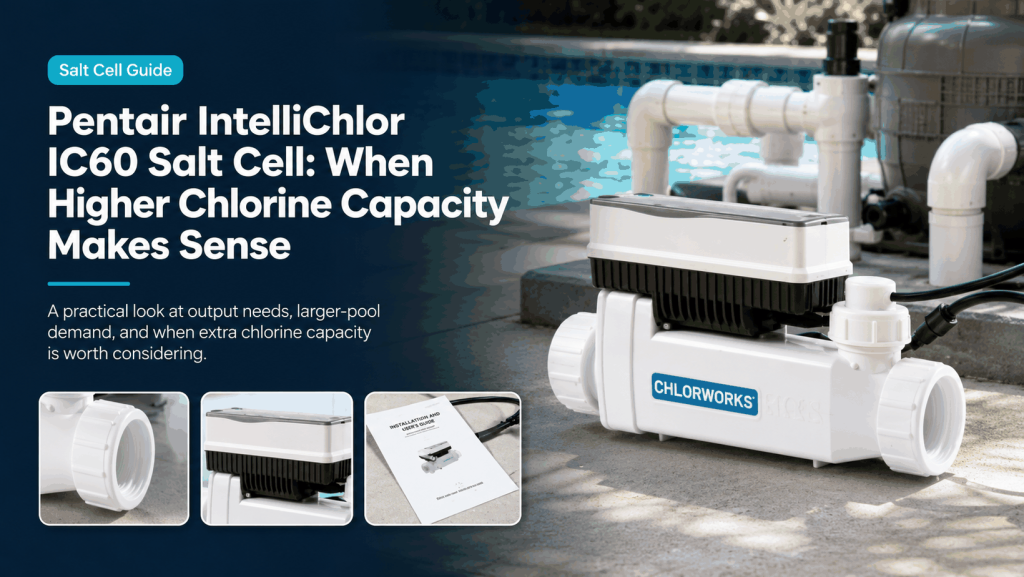
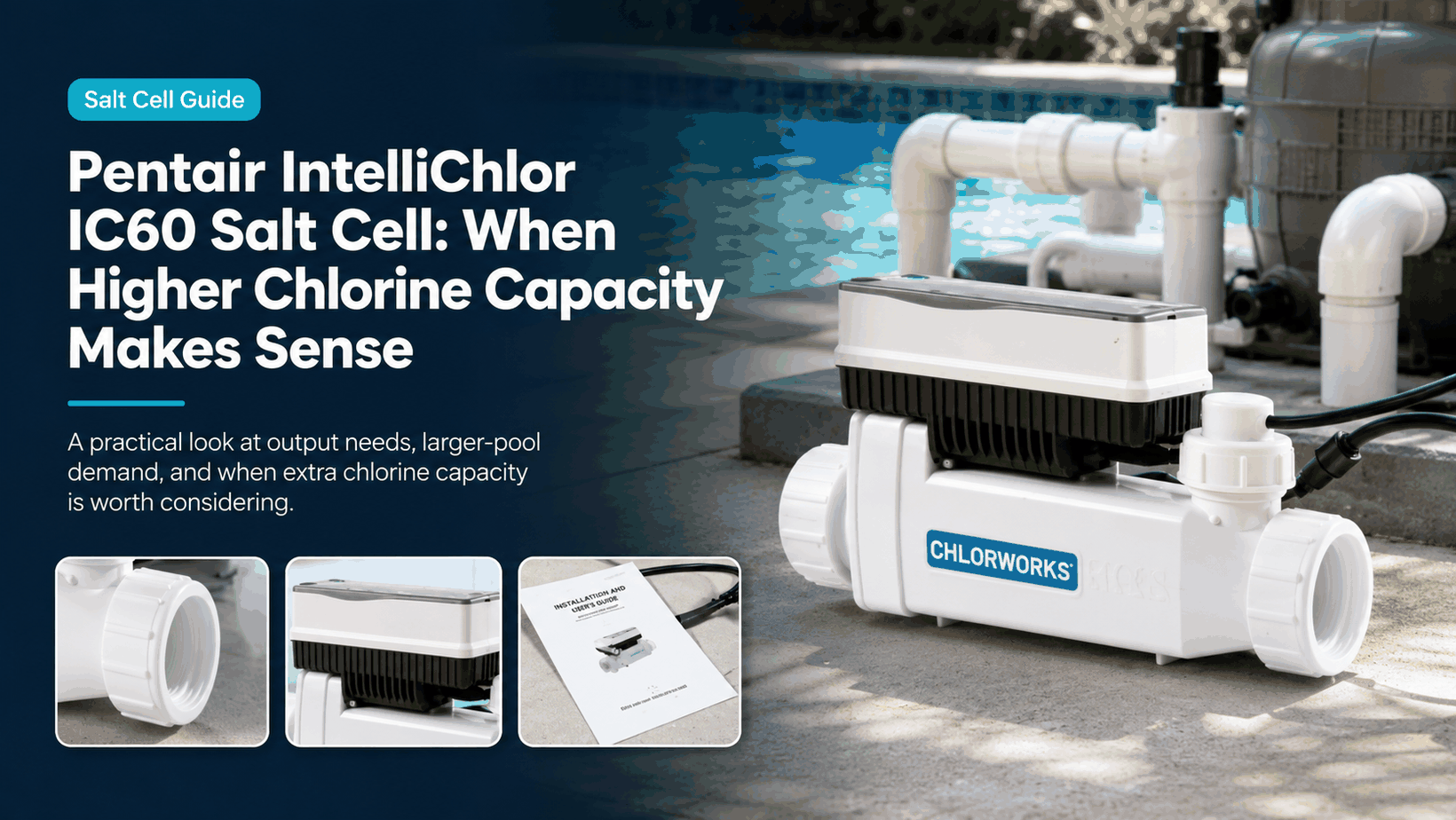
The Pentair IntelliChlor IC60 Salt Cell is the high-capacity option in the IC20/IC40/IC60 family. It is relevant not only to pools near 60,000 gallons, but also to compatible installations where an owner wants more production headroom for long swim seasons, intense sun, heavy bather load, or water features.
Oversizing should still be deliberate. A larger cell has a higher purchase cost, and the controller or power center must support it. The benefit comes when the larger production capacity lets the system meet demand at a lower duty cycle while preserving normal water balance and circulation.
Pentair IntelliChlor IC60 Salt Cell Output
Pentair identifies the IC60 for pools up to 60,000 gallons and publishes chlorine production up to 2.0 lb per 24 hours of continuous operation. The actual daily amount is reduced by the selected output percentage and the hours in which the cell is enabled.
The exact product listing is the primary internal reference for IC60 high-output chlorination and part-number identification.
High Output Creates Operating Headroom
A larger cell can meet a given daily demand at a lower percentage than a smaller compatible cell. That can be useful when the pool regularly pushes an IC40 or another cell close to maximum during peak season.
A separate IC60-family listing helps verify the Pentair 521105 salt cell context before ordering.
When High Capacity Is Useful
Pool volume is the first consideration, but it is not the only one. Long filtration schedules, very warm water, full sun, frequent parties, attached spas, and water features can all change daily chlorine demand.
Pentair’s official user guide is the best reference for a 60,000 gallon salt pool capacity comparison because it lists the IC60 model rating and operating specifications directly.
Oversizing Is About Duty Cycle, Not Overchlorinating
A larger properly controlled cell does not need to overchlorinate the pool. Output percentage and pump schedule are adjusted to maintain the target free chlorine. The value of extra capacity is the ability to meet demand without operating near the limit all the time.
Use the site’s Salt Cell Replacement category to frame the oversized salt cell benefits against cost, compatibility, and the existing cell’s seasonal workload.
521105 Compatibility And Power Requirements
Verify the installed IntelliChlor power center or compatible Pentair automation before choosing IC60. Check the manual for the supported cell types, electrical supply, flow requirements, unions, and cable routing.
Pentair’s current IntelliChlor page provides manufacturer guidance for IntelliChlor IC60 maintenance, diagnostics, manuals, and the system family.
Do not use improvised power supplies, adapters, or wiring changes. Pool equipment electrical service should be performed within manufacturer instructions and local code by qualified personnel.
Maintenance And Cell-Life Planning
More capacity does not remove the need for balanced water. Maintain salt, pH, stabilizer, calcium, and flow within the current Pentair guidance, inspect the cell for scale, and use manufacturer-approved cleaning only when needed.
For a large or high-demand pool sanitation comparison, focus on actual production needs and compatibility instead of buying the largest cell by default.
| Reason to Consider IC60 | Evidence to Gather | What to Confirm |
|---|---|---|
| Pool volume is large | Measured gallons | Within IC60 rating |
| Existing cell runs near maximum | Seasonal output history | Chemistry and flow are already correct |
| Long sunny season | Free-chlorine trend | Stabilizer and testing routine |
| High bather load | Demand after busy days | Recovery without unsafe overcorrection |
| Upgrade from smaller IC model | Current power/automation | IC60 supported by Pentair documentation |
IC60 Buying Checklist For Large Pools
- Measure actual pool volume
- Record current IntelliChlor model
- Verify 521105/IC60 part number
- Confirm power-center compatibility
- Check automation compatibility
- Test salt and free chlorine
- Inspect flow status
- Review current cell duty cycle
- Confirm unions and cable path
- Compare warranty and market version
After installation, begin with an output setting appropriate to the pool’s tested demand and adjust gradually. High capacity is most useful when it provides reserve, not when it encourages ignoring water testing.
Pentair IntelliChlor IC60 Salt Cell Ownership Records
Keep a simple service record for the Pentair IntelliChlor IC60 Salt Cell: installation date, pool volume, salt test results, output setting, pump runtime, cleaning dates, warning lights, diagnostic readings, and any replacement parts. A seasonal record makes it easier to distinguish gradual component wear from a sudden chemistry, flow, or configuration problem.
When performance changes, compare the new readings with the last period when the pool was stable. That history is more useful than replacing several parts at once, and it gives a pool professional better evidence if advanced electrical or controller diagnosis is needed.
Also record major seasonal changes such as unusually hot weather, a new pump schedule, filter service, heavy swimmer use, or a chemistry correction. Those events can change chlorination behavior without indicating hardware failure, and they make future replacement decisions more evidence-based.
Frequently Asked Questions
What pool size is the IC60 designed for?
Pentair lists the IC60 for pools up to 60,000 gallons.
How much chlorine can the IC60 produce?
Pentair documentation lists up to 2.0 lb per 24 hours of continuous operation.
Can an IC60 be used on a pool smaller than 60,000 gallons?
It may be appropriate in a compatible system when extra capacity is desired, but verify power-center support, warranty, economics, and actual demand.
Does a bigger salt cell automatically make too much chlorine?
No. Output percentage and operating time control production. Water testing should determine the setting.
What should I confirm before replacing an IC40 with IC60?
Confirm Pentair power/automation compatibility, plumbing fit, part number, pool demand, and current manufacturer guidance.
