
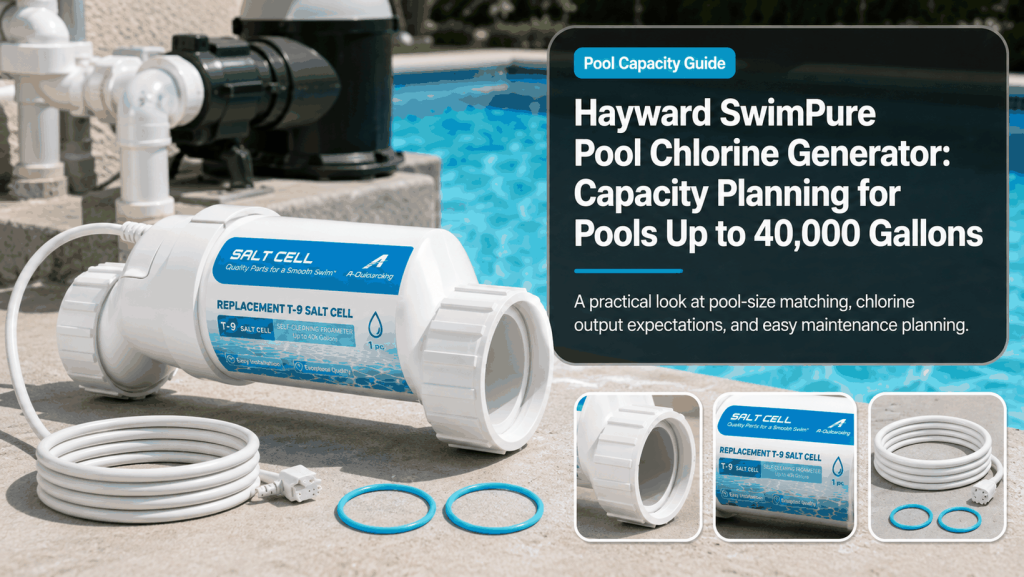
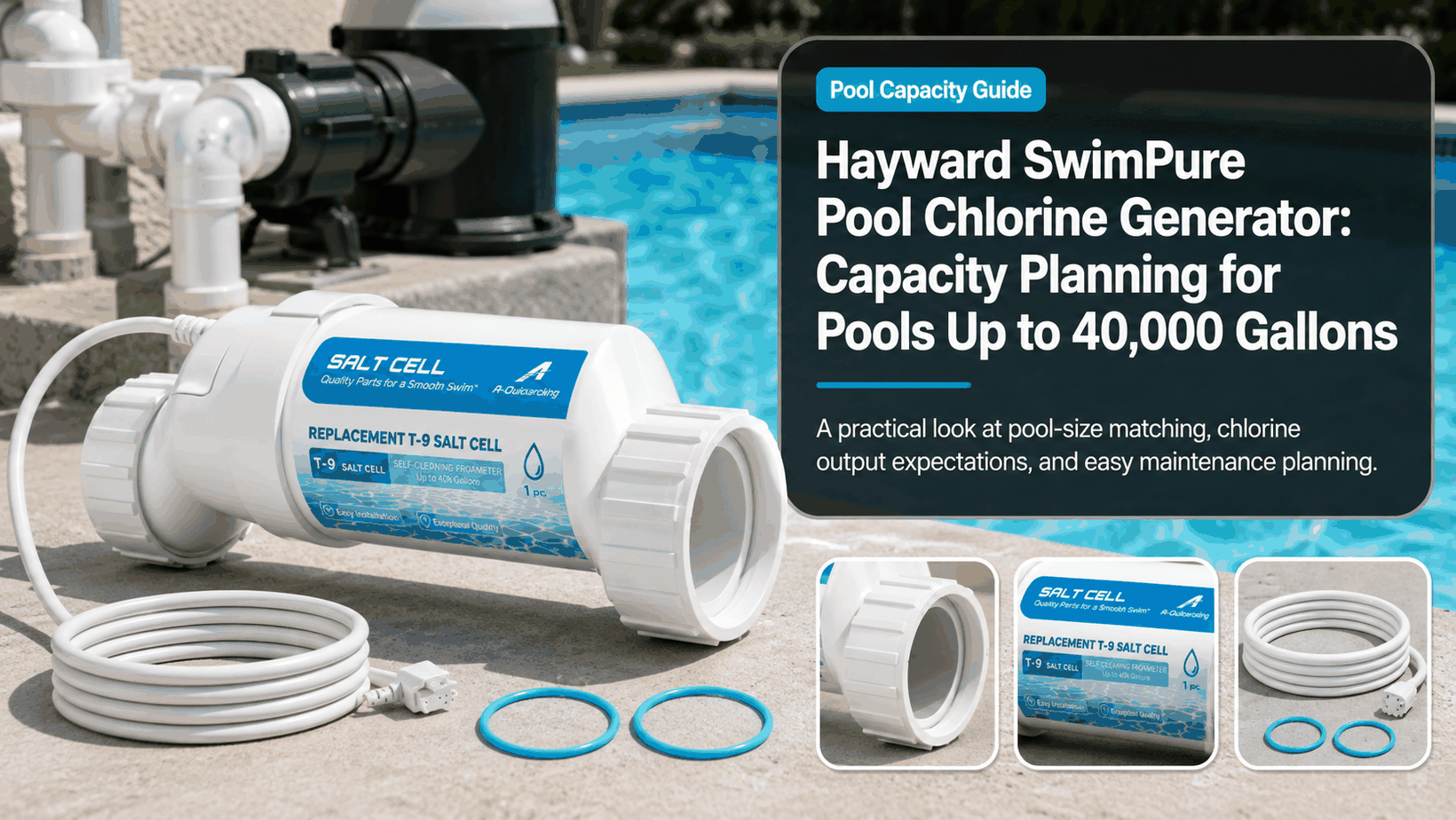
The Hayward SwimPure Pool Chlorine Generator is most useful to understand as a system: controller, flow protection, cell, circulation schedule, and water chemistry all determine whether a large pool stays sanitized. A 40,000-gallon rating is a capacity ceiling, while real production demand changes across the season.
Large inground pools can create high chlorine demand because of surface area, sunlight, bather load, water features, warm temperature, and long swim seasons. Owners should allow operating headroom and avoid choosing a replacement cell only because the union size appears correct.
Hayward SwimPure Pool Chlorine Generator Capacity Planning
Calculate pool volume carefully and verify it against refill records or construction plans when available. Even a modest error in a large pool can represent thousands of gallons, which affects how much chlorine the cell must generate each day.
A SwimPure 40K pool system reference helps identify the T-Cell-15-class replacement associated with larger SwimPure installations.
Capacity Is Only One Part Of Production
Pool volume tells you how much water must be treated. Sun, stabilizer, temperature, swimmer load, pump runtime, and target free chlorine determine how much production time the system actually needs.
Compare the system with a Hayward high-capacity chlorinator to understand the broader 40,000-gallon Hayward chlorination class without assuming every controller uses identical parts.
Choosing The Correct SwimPure Cell Class
Read the existing cell label and record the control-unit model before ordering. SwimPure and AquaRite products can share Hayward cell concepts, but compatibility should be verified from the actual system documentation.
For SwimPure salt cell sizing, compare the cell class, unions, cable, and supported controller rather than buying from gallon rating alone.
Do Not Treat A Cell As A Generic Consumable
The electrolytic cell is electronically monitored by the control system. Incorrect cell selection or configuration can create salt-reading and production problems even when the plumbing physically fits.
Managing Output On A Large Pool
Set chlorine production from measured water chemistry. If the system has to operate at maximum output for long periods merely to maintain target free chlorine, confirm stabilizer, salt, circulation, and pool volume before assuming a larger cell is the only solution.
A large inground pool sanitation comparison is useful when planning the complete circulation and chlorination load of a large pool.
For a 40,000 gallon chlorine generation decision, compare cell capacity with real operating hours and the controller’s approved cell types.
| Planning Variable | Why It Matters | What to Record |
|---|---|---|
| Pool volume | Sets base demand | Measured gallons |
| Pump runtime | Sets cell operating opportunity | Hours per day |
| Output setting | Controls production duty cycle | Percentage |
| Free chlorine | Shows sanitation result | Independent test |
| Stabilizer and pH | Affect chlorine efficiency | Water-test values |
| Water temperature | Can change cell behavior and demand | Seasonal range |
Maintenance And Diagnostic Checks
Inspect the cell for calcium scale, keep water balance in range, clean the filter when required, and resolve low-flow conditions before increasing the output setting. A scaled cell or restricted filter can make a capacity problem appear worse than it is.
Hayward documentation provides the best sequence for SwimPure maintenance checks, including no-flow, cell inspection, salt, and controller diagnostics used across the related platform.
Use appropriate protective equipment for any manufacturer-approved acid cleaning and avoid opening the energized control enclosure. Electrical diagnosis requires qualified service.
When A 40K System Needs More Headroom
- Verify pool volume
- Review peak summer chlorine demand
- Confirm cell and controller compatibility
- Test salt independently
- Confirm flow and clean filter
- Inspect cell plates
- Review pump runtime
- Check stabilizer and pH
- Compare output percentage across the season
- Record repeated low-output symptoms
A pool at or near the rated maximum may have little reserve during extreme demand. That does not automatically justify an incompatible oversize cell; any capacity change must stay within the approved control platform and installation requirements.
Hayward SwimPure Pool Chlorine Generator Ownership Records
Keep a simple service record for the Hayward SwimPure Pool Chlorine Generator: installation date, pool volume, salt test results, output setting, pump runtime, cleaning dates, warning lights, diagnostic readings, and any replacement parts. A seasonal record makes it easier to distinguish gradual component wear from a sudden chemistry, flow, or configuration problem.
When performance changes, compare the new readings with the last period when the pool was stable. That history is more useful than replacing several parts at once, and it gives a pool professional better evidence if advanced electrical or controller diagnosis is needed.
Also record major seasonal changes such as unusually hot weather, a new pump schedule, filter service, heavy swimmer use, or a chemistry correction. Those events can change chlorination behavior without indicating hardware failure, and they make future replacement decisions more evidence-based.
Frequently Asked Questions
Is SwimPure suitable for a 40,000-gallon pool?
Some SwimPure configurations use a 40,000-gallon-class cell. Verify the exact controller and cell model in the installation.
Why can a 40K cell struggle in a 40K pool?
The rating is a maximum reference. High sun, heat, swimmer load, low stabilizer, or limited pump time can raise chlorine demand.
Can I use a T-Cell-15 replacement in any SwimPure system?
Confirm the existing model and manufacturer compatibility before ordering; do not assume all SwimPure controllers use the same cell.
What should be checked before raising output to 100 percent?
Check free chlorine, stabilizer, pH, salt, flow, cell cleanliness, and pump runtime.
When is professional service appropriate?
Use professional service for electrical faults, damaged wiring, control-board issues, or unresolved diagnostics after routine checks.
