
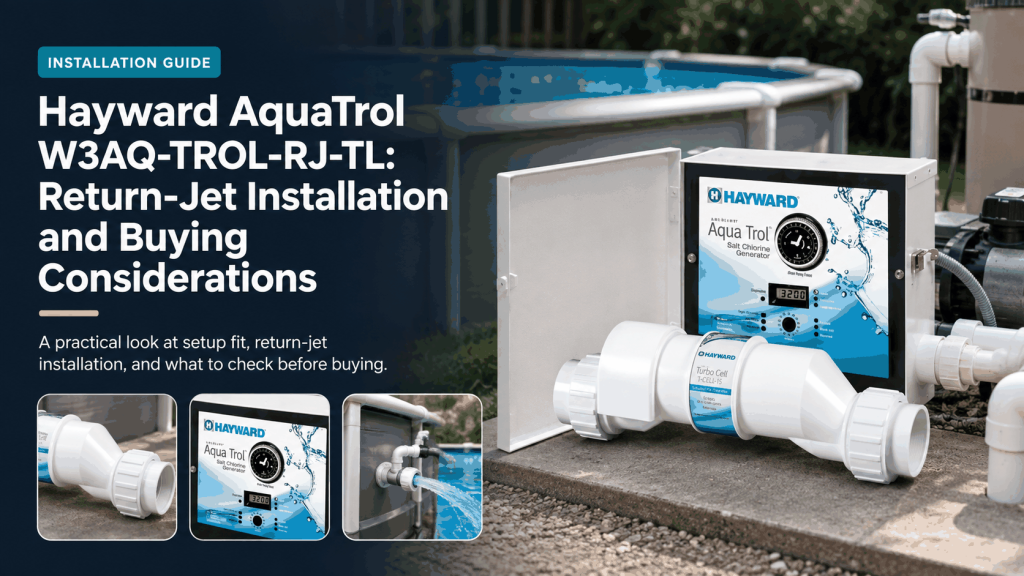
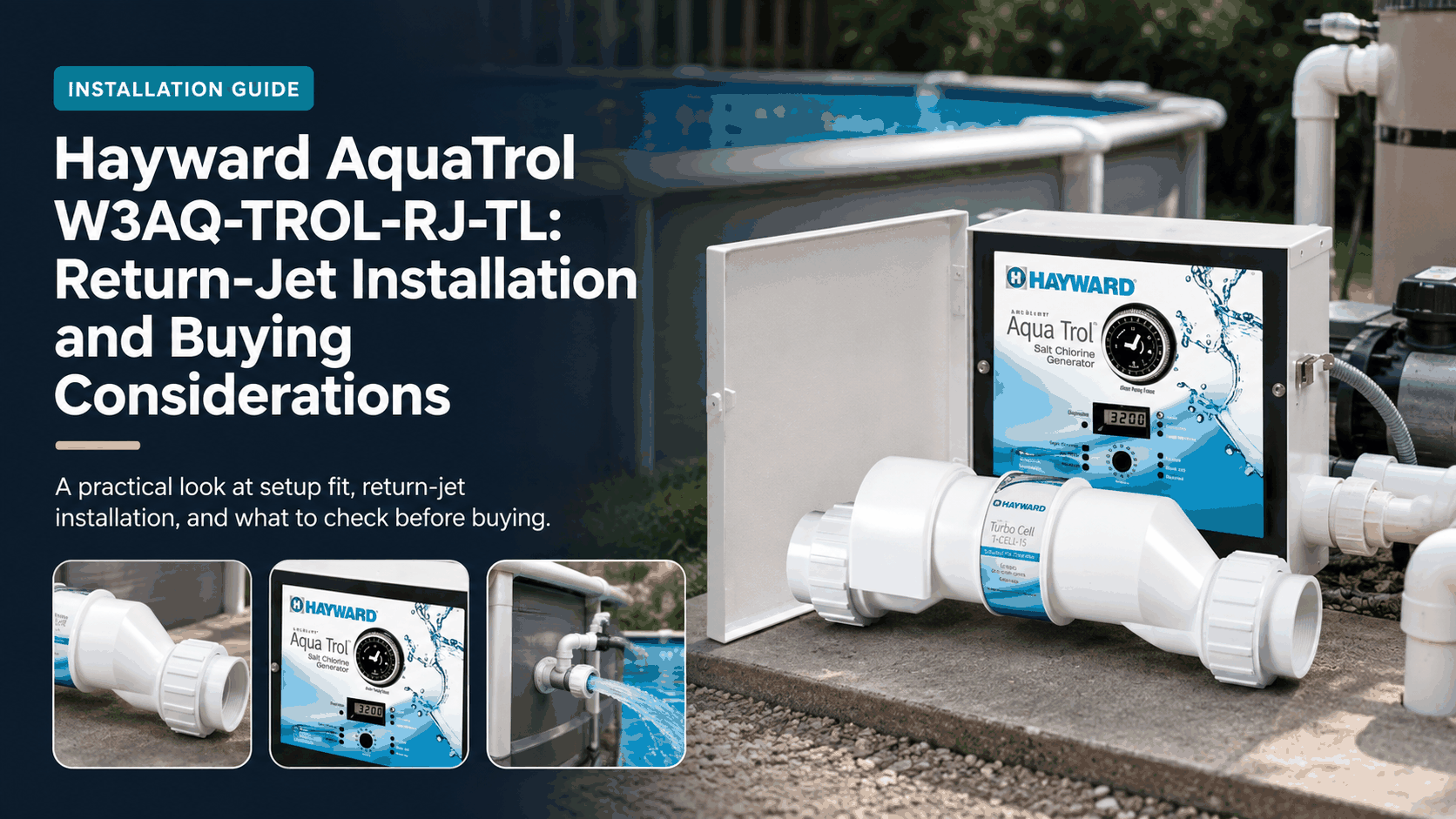
The Hayward AquaTrol W3AQ-TROL-RJ-TL differs from the hose-pipe HP version at the point where the chlorination system meets the pool. The RJ setup is built around a return-jet fitting, so existing wall-return geometry and accessible equipment location become primary buying checks.
A return-jet system can keep the equipment layout compact, but it should not be chosen without checking water flow, clearance around the wall fitting, electrical supply, pool capacity, and service access. The twist-lock configuration also needs a matching code-compliant receptacle.
Hayward AquaTrol W3AQ-TROL-RJ-TL Return-Jet Fit
Inspect the pool wall return and the space outside the wall before ordering. Return-jet chlorination places more importance on the fitting location than a hose-line system, so ladders, supports, decks, and tight clearances can affect serviceability.
The exact listing shows the AquaTrol return jet fitting configuration and should be compared with the existing return assembly.
Choose The RJ Family For The Plumbing You Actually Have
The return-jet version should not be selected simply because the control box matches another AquaTrol. The pool-side hardware and flow route differ from the hose-pipe version.
A related RJ-TL salt chlorinator reference helps compare the return-jet system family before selecting the exact cord and outlet version.
RJ-TL Plumbing And Electrical Checks
Confirm that the return fitting is structurally sound and that installation will not put twisting force on a thin pool wall. The unit needs service access for inspection and seasonal care.
For an above-ground return-line setup, compare the return geometry, cell placement, and manufacturer installation drawing with the pool’s actual wall fitting.
The twist-lock power configuration needs a suitable protected receptacle and proper grounding and bonding. Do not convert plugs or use improvised adapters around pool equipment.
If a replacement control is involved, verify the exact Hayward twist-lock outlet arrangement because control-unit variants can differ in cord and outlet style.
Capacity And Daily Output Planning
An 18,000-gallon rating gives a maximum pool-volume reference. Owners near that limit should pay close attention to the hottest weeks of the season, when warmer water, strong sun, and heavy swimming increase chlorine demand.
Use the model-specific capacity when comparing an 18K pool salt generator, then verify the exact RJ-TL fitting and electrical configuration before choosing a complete system.
| Condition | Effect on Chlorine Demand | Owner Response |
|---|---|---|
| Hot sunny week | Demand often rises | Test more often and adjust gradually |
| Heavy swimmer load | Demand can spike | Verify free chlorine after use |
| Low stabilizer | Sun destroys chlorine faster | Correct chemistry within guidance |
| Short pump schedule | Less cell operating time | Balance filtration and production |
| Restricted return flow | Can interrupt chlorination | Correct flow before increasing output |
Installation And Conversion Questions
If converting from a different return fitting, verify every supplied adapter and gasket against the current manual. Do not enlarge a pool-wall opening or change electrical wiring based only on a third-party diagram.
For an AquaTrol return-jet conversion, confirm that the fitting is intended for the exact AquaTrol and pool return before disassembling the wall fitting.
Hayward’s installation support should be used to locate the current manual and technical documentation before the pool wall or electrical supply is modified.
Routine Care For An Above-Ground Salt System
- Test salt independently
- Keep return flow unobstructed
- Inspect wall fitting for leaks
- Maintain pH and stabilizer
- Check cell plates for scale
- Avoid unnecessary acid cleaning
- Review timer after power outages
- Protect plugs and receptacles from water
- Follow seasonal winterization guidance
At shutdown, follow the manual for cell removal, draining, and freeze protection. Do not leave water trapped in a component where freezing temperatures can damage the housing or fittings.
Hayward AquaTrol W3AQ-TROL-RJ-TL Ownership Records
Keep a simple service record for the Hayward AquaTrol W3AQ-TROL-RJ-TL: installation date, pool volume, salt test results, output setting, pump runtime, cleaning dates, warning lights, diagnostic readings, and any replacement parts. A seasonal record makes it easier to distinguish gradual component wear from a sudden chemistry, flow, or configuration problem.
When performance changes, compare the new readings with the last period when the pool was stable. That history is more useful than replacing several parts at once, and it gives a pool professional better evidence if advanced electrical or controller diagnosis is needed.
Also record major seasonal changes such as unusually hot weather, a new pump schedule, filter service, heavy swimmer use, or a chemistry correction. Those events can change chlorination behavior without indicating hardware failure, and they make future replacement decisions more evidence-based.
Frequently Asked Questions
How is RJ-TL different from HP-TL?
RJ denotes the return-jet style installation, while HP versions are associated with hose-pipe fittings. TL refers to a twist-lock power configuration.
Can I replace an HP AquaTrol with an RJ model directly?
Not without checking the plumbing and electrical layout. The pool connection method differs.
Is the RJ-TL system for pools up to 18,000 gallons?
It is sold in the 18,000-gallon above-ground class. Actual operating demand still varies.
What should I check around the wall return?
Check clearance, condition of the fitting, leaks, service access, and whether the manufacturer hardware matches the pool wall.
Who should handle electrical changes?
Use a qualified electrician or pool professional for work involving the protected outlet, bonding, grounding, or line voltage.
