
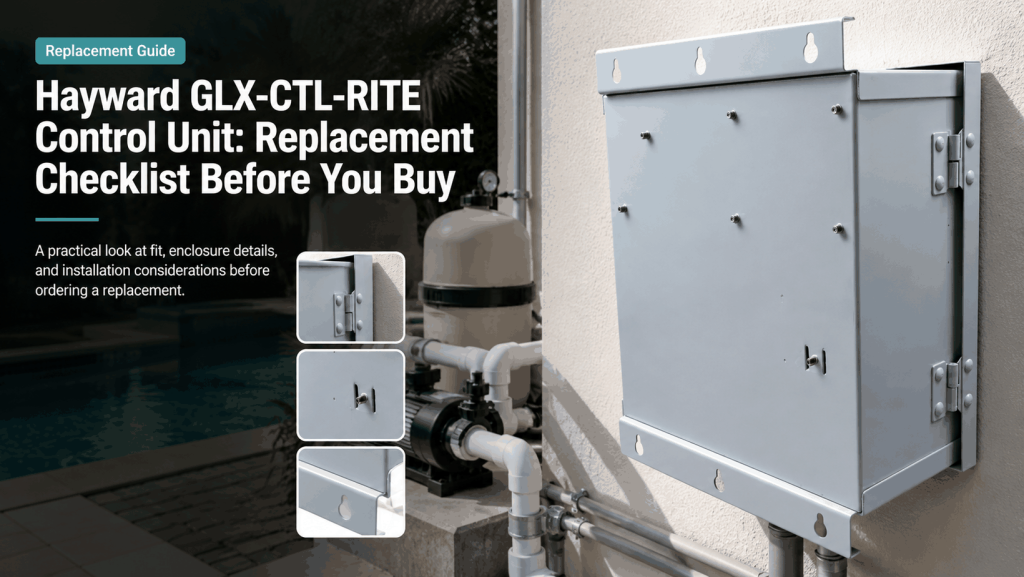
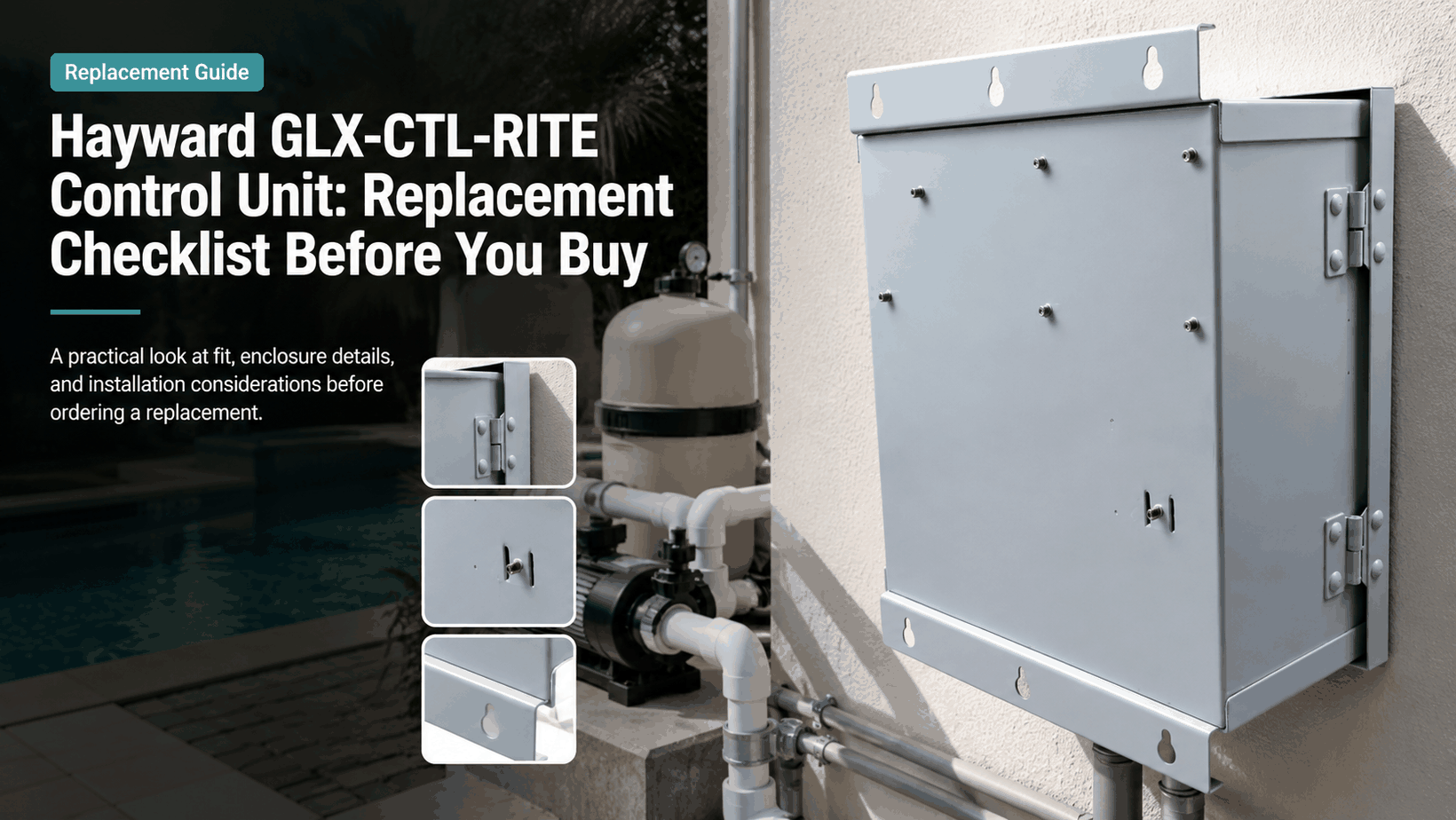
The Hayward GLX-CTL-RITE Control Unit is a major AquaRite replacement component, and buying it to solve an unconfirmed display or chlorination problem can be expensive. The controller, display board, main PCB, transformer, rectifiers, flow switch, cell, and wiring all participate in system operation.
Begin with external evidence: photograph the control label and display, record LEDs and diagnostic values, verify pump flow and the cell model, and note what changed immediately before the failure. Do not remove the panel while energized or perform line-voltage tests unless you are qualified.
Hayward GLX-CTL-RITE Control Unit Replacement Decision
A dead display, lights with no display, display with no lights, intermittent reset, or inability to energize the cell can point to different parts of the system. Replacing the entire control unit without diagnosis may solve the symptom but can also replace several working components unnecessarily.
Use the exact product reference when planning an Aqua Rite controller replacement and compare labels rather than assuming every AquaRite enclosure is the same generation.
Capture The Existing Configuration
Record supply configuration, automation connection, cell type, model label, serial number, and any accessories before removal. A photo set is valuable when commissioning the replacement or asking Hayward support a compatibility question.
Confirm AquaRite Compatibility First
A complete control-box listing can help verify GLX-CTL-RITE compatibility, but current manufacturer documentation should decide whether it fits the installed system and cell.
Verify the cell model and supported cell types because a replacement controller still needs to be configured for the installed TurboCell. Also check automation or external-control connections that may affect operation.
Do Not Confuse A Board Fault With A Whole-Enclosure Fault
Symptoms described as Hayward control box failure may sometimes trace to a board or power component rather than the enclosure itself. A qualified technician can determine whether a component-level repair is appropriate.
Separate Display, Cell, And Controller Faults
A system that displays normal information but reports no flow should be diagnosed differently from a system with no display. Likewise, low salt or low chlorine can originate in the cell, water chemistry, configuration, or circulation rather than the control unit.
For a salt generator display issue, compare whether the display PCB is a distinct service part before replacing the entire controller.
| Symptom | Likely Diagnostic Area | Avoid Assuming |
|---|---|---|
| No Flow | Hydraulics and flow switch | Entire controller has failed |
| Low salt only | Cell, salt test, configuration | Display board is bad |
| No display but LEDs present | Display circuit | Cell is bad |
| No lights or display | Power/control electronics | Flow switch is bad |
| Cell will not produce | Chemistry, flow, cell, controller | One component from symptom alone |
Safe Inspection Before Ordering
With power safely isolated, a qualified technician can inspect for obvious heat damage, corrosion, loose terminals, water intrusion, or damaged wiring. Homeowners should limit their checks to external labels, display symptoms, visible cable condition, and normal pool-maintenance items unless trained for electrical service.
Hayward’s troubleshooting document should guide any controller wiring inspection because it contains explicit high-voltage warnings and board-layout information for trained service personnel.
If a technician determines a board is the correct repair, compare the intended Aqua Rite electronics upgrade with the controller generation before ordering.
Replacement Planning And Commissioning
- Photograph the controller model label
- Record supply and automation configuration
- Record the installed cell type
- Capture current diagnostic values
- Rule out flow and chemistry problems
- Confirm exact replacement part
- Use qualified electrical service
- Program the correct cell after installation
- Reset average salt as directed
- Verify chlorine production with independent water testing
A replacement should be commissioned as a system, not just powered on. Verify cell-type programming, salt, flow, output setting, and water chemistry after installation.
Hayward GLX-CTL-RITE Control Unit Ownership Records
Keep a simple service record for the Hayward GLX-CTL-RITE Control Unit: installation date, pool volume, salt test results, output setting, pump runtime, cleaning dates, warning lights, diagnostic readings, and any replacement parts. A seasonal record makes it easier to distinguish gradual component wear from a sudden chemistry, flow, or configuration problem.
When performance changes, compare the new readings with the last period when the pool was stable. That history is more useful than replacing several parts at once, and it gives a pool professional better evidence if advanced electrical or controller diagnosis is needed.
Also record major seasonal changes such as unusually hot weather, a new pump schedule, filter service, heavy swimmer use, or a chemistry correction. Those events can change chlorination behavior without indicating hardware failure, and they make future replacement decisions more evidence-based.
Frequently Asked Questions
Does a blank AquaRite display mean I need a whole control unit?
Not necessarily. Display circuitry, power components, wiring, or the main board may be involved. Diagnose before ordering.
Can a bad cell make the controller look faulty?
Cell and chemistry problems can create warning lights and poor production, so they should be separated from display and power faults.
Can I open the AquaRite panel to inspect it?
The enclosure contains hazardous voltage. Internal inspection and electrical testing should be performed only by qualified technicians.
What should be recorded before replacing the control unit?
Record model and serial data, cell type, supply configuration, automation connections, display symptoms, diagnostic values, and photos.
What setup is needed after a replacement controller is installed?
The correct cell type, salt reading, output setting, and other manufacturer configuration steps should be verified before normal operation.
