
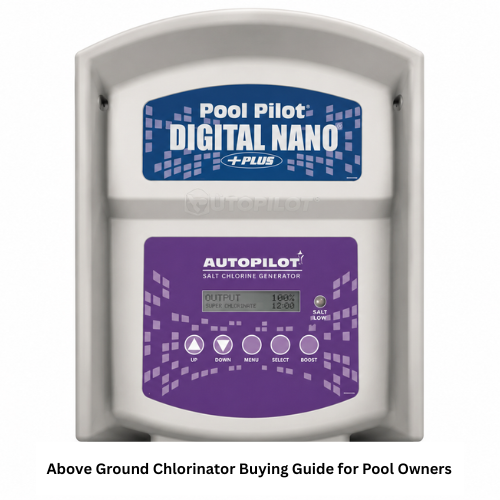
An above ground chlorinator should match the pool’s actual water volume, circulation system, plumbing size, power supply, and seasonal chlorine demand. Choosing only by price or an advertised maximum pool size can result in weak sanitation, complicated installation, or equipment that does not connect correctly.
Above-ground pools vary widely in shape, pump size, filter type, hose diameter, operating schedule, and construction. Some systems use flexible hoses, while others use rigid plumbing or a return-jet installation.
Salt chlorine generators buyers should verify every connection, electrical requirement, salt range, output control, and included accessory before purchasing.
How to Size an Above Ground Chlorinator
Begin with the pool’s actual water volume rather than its outside dimensions alone.
Use the pool manufacturer’s listed capacity when available. When calculating volume, confirm:
- Pool shape
- Length and width
- Diameter
- Average water depth
- Fill level
- Connected spa or water feature
- Seasonal water loss
- Any separate body of water
Choose a system with enough output for warm weather, sunlight, swimmers, rain, and other conditions that increase chlorine demand.
Do not assume an exact advertised maximum means the unit will maintain every pool of that size under all conditions.
| System type | Best suited to | Main advantage | Possible limitation | What to verify |
| Return-jet system | Simple above-ground plumbing | May reduce major pipe changes | Requires correct return fitting | Wall and jet compatibility |
| Inline hose system | Flexible-hose pools | Connects within circulation line | Hose adapters may be required | Hose diameter |
| Rigid-plumbed system | Permanently installed equipment pads | Secure professional-style layout | More installation work | Pipe size and unions |
| Combined pump and salt system | Pools needing coordinated filtration and chlorination | One matched equipment package | Replacing one part may affect the full system | Pump flow and pool volume |
Confirm Pool Volume and Chlorine Demand
An above ground chlorinator should produce enough chlorine during the pool’s normal pump runtime.
Factors that increase demand include:
- Direct sunlight
- High water temperature
- Frequent swimming
- Rain
- Windblown debris
- Leaves and pollen
- Low stabilizer
- Algae
- Poor filtration
- Large water features
Oversizing within the manufacturer’s approved guidance can provide more operating flexibility, but an excessively large or incompatible system is not automatically better.
Verify output rather than relying only on the pool-gallon label.
Check the Existing Pump and Filter
The generator normally operates only when water is circulating.
Identify:
- Pump model
- Filter type
- Pump flow
- Hose or pipe size
- Normal operating pressure
- Timer schedule
- Return fitting
- Valve arrangement
- Available straight plumbing length
The salt system must receive adequate flow without exceeding its stated operating limits.
A small pump may not activate a flow switch or may provide poor circulation through a complicated installation.
Plumbing and Hose Compatibility
Above-ground equipment may use:
- Small flexible hoses
- Larger flexible hoses
- Threaded adapters
- Clamp connections
- PVC pipe
- Return-jet fittings
- Proprietary unions
An above-ground chlorinator selection guide can help shoppers compare plumbing layouts, output, controls, and pool capacity.
Before ordering, measure:
- Inside and outside hose diameter
- Pipe diameter
- Thread type
- Union spacing
- Return opening
- Equipment-pad space
- Cell orientation
- Required straight-pipe distance
Do not assume a generic adapter will create a safe connection.
Return-Jet and Inline Systems
A return-jet system mounts near the pool’s return opening and may be practical for simple layouts.
An inline system sits within the circulation plumbing and may provide greater flexibility when the pump and filter already use suitable hoses or PVC.
Compare:
- Installation position
- Required cutting
- Included unions
- Hose adapters
- Bypass requirements
- Flow direction
- Cell access
- Winter removal
- Leak points
The Hayward AquaTrol salt system can help buyers examine a return-jet above-ground configuration, but verify the current pool limit, cell, voltage, timer, unions, and included hardware.
Converting an Existing Pool
An above-ground salt system benefits guide can help owners compare daily operation, water testing, and equipment changes before converting.
Before conversion:
- Inspect the liner.
- Check metal components.
- Review equipment warranties.
- Repair leaks.
- Test water chemistry.
- Confirm pump performance.
- Identify electrical needs.
- Plan cell location.
- Confirm drainage rules.
- Purchase the correct amount of salt only after testing.
A salt system still produces chlorine. It does not eliminate the need for sanitation, testing, filtration, brushing, or water balance.
Integrated Pump and Salt Systems
Some seasonal pools use a combined filter pump and saltwater generator.
This may simplify matching the equipment, but buyers should confirm:
- Pump flow
- Filter capacity
- Pool connection size
- Cartridge or media requirements
- Timer operation
- Replacement cell availability
- Replacement pump parts
- Storage requirements
- Winterization steps
The Intex above-ground saltwater system provides one example of an integrated seasonal setup, but verifies the current pool-volume range, pump requirements, connections, voltage, included parts, and seller information.
Warranty, Returns, and Replacement Parts
Before ordering, review:
- Control-box warranty
- Cell warranty
- Prorated coverage
- DIY-installation rules
- Registration requirements
- Return window
- Installed-equipment restrictions
- Replacement cell availability
- Adapter availability
- Flow-switch availability
- Delivery tracking
- Seller support
The Hayward AquaTrol above-ground chlorination system listing can help buyers compare a complete system, but verify its current pool capacity, installation type, cell, voltage, warranty, seller, and package contents.
Inspect all parts before adding salt, cutting hoses, or installing equipment.
Conclusion
The best above ground chlorinator is correctly sized for the pool, compatible with the pump and plumbing, safe for the pool materials, and supported by available replacement cells and parts. Measure the complete installation, review electrical requirements, compare output controls, and understand warranty and winter-storage needs before choosing a system.
FAQ
Can every above-ground pool use a salt system?
No. Confirm compatibility with the liner, frame, ladder, heater, pump, filter, and equipment warranties.
How large should the chlorinator be?
Choose a system with an approved capacity and enough chlorine output for the pool’s volume, climate, sunlight, and normal use.
Can I connect a salt system to flexible pool hoses?
Some models support hose connections, while others require adapters or rigid plumbing. Verify the exact fittings.
Does a saltwater pool still need chlorine testing?
Yes. The system produces chlorine, so owners must continue testing and balancing the water.
Can the system remain outside during winter?
Storage requirements vary. Follow the instructions for draining, cell removal, freeze protection, and controller storage.
