
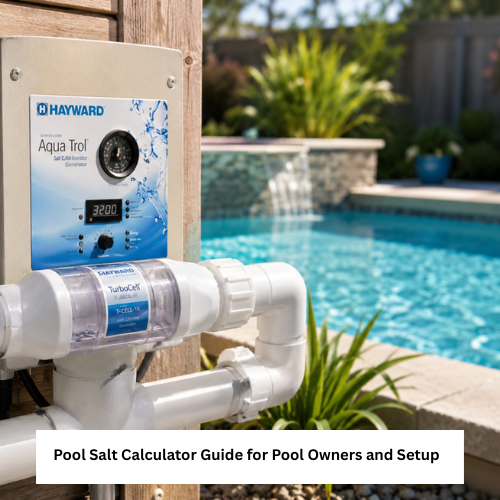
A pool salt calculator helps pool owners estimate how much salt to add by comparing pool volume, current salt reading, and the target range listed in the salt chlorine generator manual. This is important because adding too much or too little salt can affect water balance, chlorine output, and system performance.
For saltwater pools, salt should never be added by guesswork. Test the water first, confirm your pool size, check the generator’s recommended salt range, and add salt slowly so the system has time to circulate and mix properly.
Why Salt Level Matters in a Saltwater Pool
Saltwater pools still need balanced water and proper sanitizing. The salt chlorine generator uses dissolved salt to help produce chlorine, but it can only work properly when the salt level is within the correct operating range for that system.
If the salt level is too low, the generator may not produce enough chlorine. If it is too high, the system may show warnings or require dilution. Always follow the manual for your exact model.
How to Use a Pool Salt Calculator
A pool salt calculator can prevent guesswork by using pool volume, current salt level, and target salt level. One common calculation uses pool gallons and the ppm increase needed, but pool owners should still verify the final amount with their generator manual and water test results.
Before relying on a pool salt calculator, confirm:
- Pool volume
- Current salt reading
- Target salt level from the manual
- Water test accuracy
- Type of pool salt
- Circulation time
- Whether water was recently add
- Whether rain diluted the pool
- Generator warning messages
- Return policy on pool salt or test products
| Situation | What It May Mean | What to Check | What to Verify Before Adding Salt |
| Salt reads low | Pool may need more salt | Test result and pool volume | Generator target range |
| Salt reads high | Too much salt may be present | Recent additions and test accuracy | Dilution guidance from manual |
| Reading changes after rain | Water may be diluted | Water level and salt test | New test before adding salt |
| Generator shows warning | Salt may be outside range | System display and cell condition | Model-specific troubleshooting |
| Pool was recently filled | Salt may not be mixed yet | Circulation time | Retest after mixing |
Pool Salt Level and Testing Accuracy
A saltwater pool calculator works best when the current reading is tested accurately before salt is added. If the test result is wrong, the calculator output will also be wrong.
Use fresh test strips, a digital reader, or a reliable testing method that matches your pool care routine. If results seem unusual, retest before adding more salt.
For product comparison, review salt test strip options and verify test range, package condition, expiration details if listed, instructions, and return policy before buying.
Swimming Pool Salt and Mixing Tips
Use swimming pool salt that is intended for pool use, and verify the product details before buying. Do not assume every salt product is suitable for saltwater pool systems.
Add salt slowly and brush the pool floor if needed to help it dissolve. Run the pump long enough for circulation, and wait before retesting so the reading reflects mixed water rather than one concentrated area.
Saltwater Chlorinator Guide for Setup
A saltwater chlorinator guide can help pool owners understand how salt level, water flow, cell condition, and system settings work together. Salt alone does not keep water clear if the generator, pump, filter, or chemistry is not working properly.
During setup, check that the pump is running, valves are positioned correctly, and the generator is install according to the manual. If the system has alerts, read the manual before adding more salt.
Pool Salt System Maintenance Notes
A pool salt system should be checked regularly for salt level, water balance, cell condition, and flow. If the cell is scaled or the water is unbalanced, the system may not produce chlorine properly even if the salt number looks correct.
Maintenance tips:
- Test salt before adding more
- Keep the pump and filter working properly
- Check generator alerts
- Inspect the salt cell as directed
- Avoid adding large amounts at once
- Retest after circulation
- Store pool salt dry
- Keep records of salt additions
Common Pool Salt Mistakes
Avoid these mistakes:
- Adding salt without testing first
- Guessing pool volume
- Ignoring the generator manual
- Adding all salt at once
- Testing before salt is fully mix
- Confusing low chlorine with low salt
- Skipping cell and filter checks
- Not checking return policy before buying supplies
Troubleshooting Salt Level Problems
If the salt reading stays low after adding salt, wait for proper circulation and retest. If the result still looks wrong, check the test method, water volume estimate, and generator sensor or cell condition.
If salt reads high, do not add more salt. Check the manual for next steps. Some situations may require partial water replacement, but verify the correct approach for your pool and equipment.
Practical Buying Checklist
Before buying salt, test products, or related equipment, confirm:
- Size or fit: Salt amount matches pool volume and current test reading
- Compatibility: Salt and test method work with your saltwater pool system
- Safety: Product handling, storage, and pool-use directions are clear
- Material or build quality: Test strips, containers, bags, or tools look sealed and usable
- Setup or installation: Adding, mixing, and retesting steps are clear
- Maintenance: Testing schedule and system checks are manageable
- Warranty: Verify before buying if listed
- Return policy: Check before ordering
- Replacement parts: Verify test strips, sensors, salt cells, or system parts if needed
- Delivery or support: Confirm arrival before setup or pool opening
- Verify before buying: Do not assume salt target, pool volume, product suitability, or test accuracy
Conclusion
A pool salt calculator is useful for estimating salt needs, but it use with accurate water testing, correct pool volume, and the salt chlorine generator manual. Add salt slowly, circulate fully, and retest before making more adjustments so the pool salt calculator supports safer pool maintenance.
FAQ
What does a pool salt calculator do?
It estimates how much salt to add based on pool volume, current salt level, and target salt level.
Should I test water before adding salt?
Yes. Always test first so you do not add too much salt.
Can I use any salt in a saltwater pool?
No. Verify that the salt product is intended for pool use before buying.
Why is my salt reading still low after adding salt?
The salt may not be fully mixed, the test may be inaccurate, or the system may need troubleshooting.
What should I verify before buying salt products?
Verify pool-use suitability, test accuracy, packaging, storage instructions, return policy, and system compatibility.
