
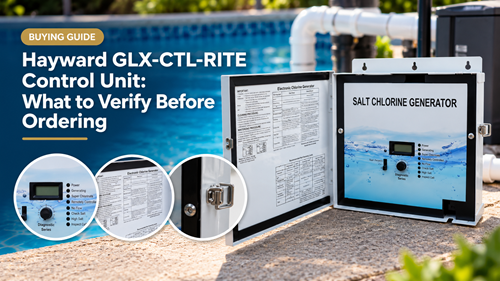

Hayward GLX-CTL-RITE Control Unit should be selected by matching the exact system, pool demand, controller or power hardware, plumbing fit, and service condition—not by product name alone. GLX-CTL-RITE style replacements are complete AquaRite control-unit replacements and must be matched to the existing salt-cell type, voltage, wiring and control-box application.
The practical goal is to confirm what the existing system actually needs before buying. AquaRite/Goldline application, cell type such as T-CELL-3/T-CELL-9/T-CELL-15, voltage wiring, display/board architecture and sensor connections. That prevents an expensive replacement from masking a flow, chemistry, wiring, or setup problem.
How To Evaluate Hayward GLX-CTL-RITE Control Unit
Hayward GLX-CTL-RITE Control Unit belongs in a complete saltwater-pool system. Its real performance depends on water flow, salt concentration, free-chlorine demand, temperature, pH, stabilizer, filtration and the condition of the surrounding control hardware.
GLX-CTL-RITE style replacements are complete AquaRite control-unit replacements and must be matched to the existing salt-cell type, voltage, wiring and control-box application. The published capacity is a useful ceiling, but it should be treated as a compatibility reference rather than a promise that every pool at that size will have identical chlorine demand.
Before replacement, capture the existing model number, serial or revision information, cable and connector style, union or plumbing dimensions, controller setting, warning lights and current water-test results. That record makes the decision repeatable and reduces guesswork after the new part is installed.
Compatibility And Buying Checks
AquaRite Control Unit
Use AquaRite control unit as the first sizing or fit checkpoint. Controller capacity follows the supported cell selection and system configuration rather than one fixed pool-size number is useful only when it matches the actual pool, controller family, and peak-season sanitizer demand rather than a best-case label number.
Hayward Control Replacement
Treat Hayward control replacement as a compatibility question, not a marketing phrase. Match the old equipment label, control platform, plumbing or union arrangement, cable/connector style, and the part family before ordering a replacement or upgrade.
Pool Salt System Controls
Before changing hardware, verify pool salt system controls against the current installation. AquaRite/Goldline application, cell type such as T-CELL-3/T-CELL-9/T-CELL-15, voltage wiring, display/board architecture and sensor connections. A mismatch can create false salt readings, flow warnings, no-output conditions, or a part that physically fits but cannot operate correctly.
Electrical Compatibility
Use electrical compatibility to confirm the manufacturer procedure before installation or programming. Verify model labels and diagnose the existing board, transformer, rectifiers, flow switch, cell and wiring before replacing the complete control unit. This is especially important when the work involves electrical connections, controller settings, flow sensors, probes, or system calibration.
Chlorinator Repair
Review chlorinator repair together with actual pump operation and water testing. The control unit manages power, output percentage, diagnostics and cell settings; it does not replace the cell itself. An apparently weak chlorinator can be caused by short circulation time, dirty filtration, scale, cold water, or high chlorine demand rather than failed hardware.
Model Identification
Use model identification as the final maintenance and replacement check. Record the installed model, settings and baseline water readings so future troubleshooting can separate normal wear from chemistry, flow, electrical, or controller problems.
Buying Checklist And Decision Table
Use this table before ordering so the purchase is based on confirmed fit and operating need instead of appearance alone.
| Decision Point | What To Verify | Why It Matters |
|---|---|---|
| Model / part number | Match the current equipment label | Prevents cross-family replacements |
| Pool or system capacity | controller capacity follows the supported cell selection and system configuration rather than one fixed pool-size number | Avoids undersizing or unnecessary oversizing |
| Controller / power fit | AquaRite/Goldline application, cell type such as T-CELL-3/T-CELL-9/T-CELL-15, voltage wiring, display/board architecture and sensor connections | Ensures the new part can actually operate |
| Plumbing / connector fit | Compare unions, cable, flow direction and available space | Avoids forced fittings and wiring workarounds |
| Operating demand | The control unit manages power, output percentage, diagnostics and cell settings; it does not replace the cell itself | Connects hardware choice to real chlorine need |
| Service condition | Inspect flow, chemistry, scale, wiring and warning history | Prevents replacing the wrong component |
Installation And Replacement Workflow
- Photograph the existing equipment label and wiring/plumbing layout
- Measure or confirm actual pool volume
- Test salt and free chlorine independently
- Confirm pump flow and filtration condition
- Record controller settings and warning lights
- Shut off power before opening or disconnecting equipment
- Compare unions, connectors, cord length and service clearance
- Install only in the manufacturer-approved orientation
- Restart with balanced water and the correct cell/system setting
- Retest chlorine output and inspect for leaks or new alerts
Keep the old part until the replacement has run through a normal operating cycle. If the new hardware immediately shows the same warning, return to diagnosis instead of changing several settings at once.
Safety And Troubleshooting Before Replacement
Verify model labels and diagnose the existing board, transformer, rectifiers, flow switch, cell and wiring before replacing the complete control unit. Never bypass a flow switch, defeat grounding or bonding, force a connector, or energize an electrolytic cell without the required water flow.
Low chlorine can come from algae or organic demand, short pump runtime, poor stabilizer balance, scale, a dirty filter, incorrect salinity, cold-water operation, or an undersized system. Verify water chemistry and circulation before assuming the hardware has failed.
Final Buying Decision
Hayward GLX-CTL-RITE Control Unit is the right purchase when the part number or system family, physical fit, control requirements and actual pool demand all agree. GLX-CTL-RITE style replacements are complete AquaRite control-unit replacements and must be matched to the existing salt-cell type, voltage, wiring and control-box application.
Use the old equipment as the baseline, verify the current manufacturer documentation, and keep the installation and water-test record. That approach gives the replacement the best chance to solve the real problem instead of creating a second compatibility issue.
Frequently Asked Questions
How do I know whether Hayward GLX-CTL-RITE Control Unit is compatible?
Match the existing model/part label, controller or power hardware, connections, plumbing and manufacturer compatibility information. Do not choose by appearance alone.
What capacity should I use?
Use controller capacity follows the supported cell selection and system configuration rather than one fixed pool-size number as the published reference, then account for climate, pump runtime, bather load and peak chlorine demand.
Can I install or replace this part myself?
Simple cell or plumbing replacements may be manageable for experienced owners, but electrical, circuit-board, control-unit and probe work should follow the manual and may require qualified service.
Why can chlorine stay low after replacement?
The replacement may be correct while the pool still has high chlorine demand, poor flow, inadequate pump runtime, low stabilizer, scale, dirty filtration or incorrect salt/water balance.
What should I record after installation?
Record the model, date, controller settings, salt level, free chlorine, pH, pump schedule and any diagnostic readings. Those baseline values make future troubleshooting much easier.
