
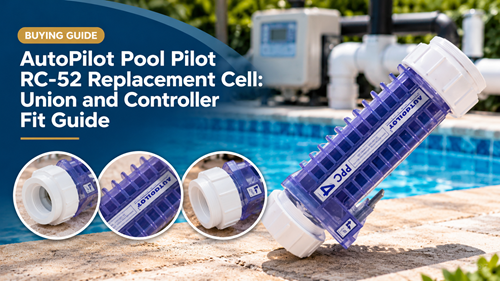

AutoPilot Pool Pilot RC-52 Replacement Cell should be selected by matching the exact system, pool demand, controller or power hardware, plumbing fit, and service condition—not by product name alone. AutoPilot lists RC52 as a replacement cell option available with female unions, with a no-union version also documented for compatible Pool Pilot installations.
The practical goal is to confirm what the existing system actually needs before buying. Pool Pilot controller, RC-52 cell selection, union configuration, cable connector, manifold/plumbing dimensions, and system firmware/settings. That prevents an expensive replacement from masking a flow, chemistry, wiring, or setup problem.
How To Evaluate AutoPilot Pool Pilot RC-52 Replacement Cell
AutoPilot Pool Pilot RC-52 Replacement Cell belongs in a complete saltwater-pool system. Its real performance depends on water flow, salt concentration, free-chlorine demand, temperature, pH, stabilizer, filtration and the condition of the surrounding control hardware.
AutoPilot lists RC52 as a replacement cell option available with female unions, with a no-union version also documented for compatible Pool Pilot installations. The published capacity is a useful ceiling, but it should be treated as a compatibility reference rather than a promise that every pool at that size will have identical chlorine demand.
Before replacement, capture the existing model number, serial or revision information, cable and connector style, union or plumbing dimensions, controller setting, warning lights and current water-test results. That record makes the decision repeatable and reduces guesswork after the new part is installed.
Compatibility And Buying Checks
RC52 Salt Cell
Use RC52 salt cell as the first sizing or fit checkpoint. Capacity and output depend on the exact pool pilot controller/system configuration; match the rc-52 part family rather than guessing from physical size is useful only when it matches the actual pool, controller family, and peak-season sanitizer demand rather than a best-case label number.
Pool Pilot Digital
Treat Pool Pilot Digital as a compatibility question, not a marketing phrase. Match the old equipment label, control platform, plumbing or union arrangement, cable/connector style, and the part family before ordering a replacement or upgrade.
AutoPilot Cell Compatibility
Before changing hardware, verify AutoPilot cell compatibility against the current installation. Pool Pilot controller, RC-52 cell selection, union configuration, cable connector, manifold/plumbing dimensions, and system firmware/settings. A mismatch can create false salt readings, flow warnings, no-output conditions, or a part that physically fits but cannot operate correctly.
Replacement Unions
Use replacement unions to confirm the manufacturer procedure before installation or programming. Photograph the old cell label, cable, unions, manifold, flow direction, and controller model before disassembly; compare them with the RC-52 documentation. This is especially important when the work involves electrical connections, controller settings, flow sensors, probes, or system calibration.
Cell Cable
Review cell cable together with actual pump operation and water testing. Restored output depends on correct controller pairing, water balance, salt level, flow, and a healthy power/control system. An apparently weak chlorinator can be caused by short circulation time, dirty filtration, scale, cold water, or high chlorine demand rather than failed hardware.
Saltwater System
Use saltwater system as the final maintenance and replacement check. Record the installed model, settings and baseline water readings so future troubleshooting can separate normal wear from chemistry, flow, electrical, or controller problems.
Buying Checklist And Decision Table
Use this table before ordering so the purchase is based on confirmed fit and operating need instead of appearance alone.
| Decision Point | What To Verify | Why It Matters |
|---|---|---|
| Model / part number | Match the current equipment label | Prevents cross-family replacements |
| Pool or system capacity | capacity and output depend on the exact Pool Pilot controller/system configuration; match the RC-52 part family rather than guessing from physical size | Avoids undersizing or unnecessary oversizing |
| Controller / power fit | Pool Pilot controller, RC-52 cell selection, union configuration, cable connector, manifold/plumbing dimensions, and system firmware/settings | Ensures the new part can actually operate |
| Plumbing / connector fit | Compare unions, cable, flow direction and available space | Avoids forced fittings and wiring workarounds |
| Operating demand | Restored output depends on correct controller pairing, water balance, salt level, flow, and a healthy power/control system | Connects hardware choice to real chlorine need |
| Service condition | Inspect flow, chemistry, scale, wiring and warning history | Prevents replacing the wrong component |
Installation And Replacement Workflow
- Photograph the existing equipment label and wiring/plumbing layout
- Measure or confirm actual pool volume
- Test salt and free chlorine independently
- Confirm pump flow and filtration condition
- Record controller settings and warning lights
- Shut off power before opening or disconnecting equipment
- Compare unions, connectors, cord length and service clearance
- Install only in the manufacturer-approved orientation
- Restart with balanced water and the correct cell/system setting
- Retest chlorine output and inspect for leaks or new alerts
Keep the old part until the replacement has run through a normal operating cycle. If the new hardware immediately shows the same warning, return to diagnosis instead of changing several settings at once.
Safety And Troubleshooting Before Replacement
Photograph the old cell label, cable, unions, manifold, flow direction, and controller model before disassembly; compare them with the RC-52 documentation. Never bypass a flow switch, defeat grounding or bonding, force a connector, or energize an electrolytic cell without the required water flow.
Low chlorine can come from algae or organic demand, short pump runtime, poor stabilizer balance, scale, a dirty filter, incorrect salinity, cold-water operation, or an undersized system. Verify water chemistry and circulation before assuming the hardware has failed.
Final Buying Decision
AutoPilot Pool Pilot RC-52 Replacement Cell is the right purchase when the part number or system family, physical fit, control requirements and actual pool demand all agree. AutoPilot lists RC52 as a replacement cell option available with female unions, with a no-union version also documented for compatible Pool Pilot installations.
Use the old equipment as the baseline, verify the current manufacturer documentation, and keep the installation and water-test record. That approach gives the replacement the best chance to solve the real problem instead of creating a second compatibility issue.
Frequently Asked Questions
How do I know whether AutoPilot Pool Pilot RC-52 Replacement Cell is compatible?
Match the existing model/part label, controller or power hardware, connections, plumbing and manufacturer compatibility information. Do not choose by appearance alone.
What capacity should I use?
Use capacity and output depend on the exact Pool Pilot controller/system configuration; match the RC-52 part family rather than guessing from physical size as the published reference, then account for climate, pump runtime, bather load and peak chlorine demand.
Can I install or replace this part myself?
Simple cell or plumbing replacements may be manageable for experienced owners, but electrical, circuit-board, control-unit and probe work should follow the manual and may require qualified service.
Why can chlorine stay low after replacement?
The replacement may be correct while the pool still has high chlorine demand, poor flow, inadequate pump runtime, low stabilizer, scale, dirty filtration or incorrect salt/water balance.
What should I record after installation?
Record the model, date, controller settings, salt level, free chlorine, pH, pump schedule and any diagnostic readings. Those baseline values make future troubleshooting much easier.
